

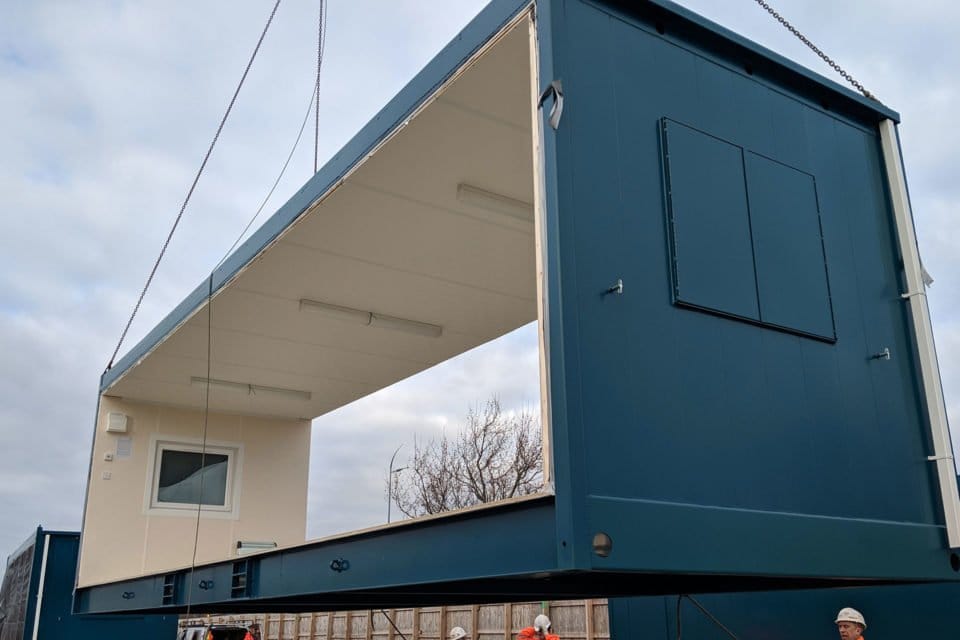
A successful container delivery begins before the vehicle arrives. The route to your property, the ground at the placement area and the position of the doors all affect how straightforward the job will be. Planning early helps you avoid choosing a container that cannot be placed where you intended.
Share the delivery details first
Provide the full postcode, a description of the entrance and photographs of the route from the road to the proposed position. Include any tight bends, slopes, narrow gates or surfaces that may become soft in wet weather.
Tell the delivery team about overhead cables, trees, buildings, drains and other restrictions. Photographs are useful, but they do not replace a delivery assessment where one is needed. Do not assume the vehicle or lifting equipment will fit because another lorry has visited previously.
Check access for the delivery vehicle
The container footprint is only part of the space requirement. The delivery vehicle needs room to approach, manoeuvre and operate. The required clearances depend on the container, vehicle, lifting arrangement and site conditions.
Measure the narrowest points and share those measurements rather than estimating. If access passes through neighbouring land or a managed site, arrange any necessary permission and access in advance.
Prepare a suitable base
The placement area should be suitable for the loaded container and the proposed delivery operation. Uneven support can affect door operation, while soft or poorly drained ground can cause longer-term problems.
Ask the supplier to confirm the support requirements for the exact container. Where groundwork or structural advice is needed, use a competent local professional. Avoid choosing a base solely from a photograph of someone else’s installation: ground conditions and loads differ.
Plan door opening and daily access
Decide which way the doors should face before the delivery is booked. Leave enough space for the doors to open and for people to move stored items safely. Consider future shelving, steps, paths and the route from your building to the container.
If you need to move wide equipment or access stock frequently, confirm the clear opening dimensions. A container’s nominal external size does not tell you the maximum item size that can pass through the doors.
Agree the unloading and positioning arrangements
Ask how the container will be unloaded, where it can be positioned and what the delivery quote includes. Lifting over a wall, working near overhead restrictions or reaching into a confined area requires specific assessment. Never assume an unusual lift is included without written confirmation.
Make sure a responsible person is available on delivery day to provide access and confirm the agreed position. Keep the operating area clear and follow the driver’s instructions.
Your pre-delivery checklist
- Confirm the product size, door orientation and intended location.
- Send access measurements and up-to-date site photographs.
- Disclose overhead restrictions, soft ground and buried services.
- Prepare the agreed base and clear the approach.
- Confirm delivery scope, access arrangements and a site contact.
Browse the Wallis Containers shop and read our shipping policy. To discuss a proposed location, contact our team with your postcode, container choice and site photographs.
Related buying guides
Read 10ft, 20ft or 40ft Shipping Container: Which Size Do You Need? and Flat Pack Storage Containers: What to Check Before Buying for more practical advice, or browse all Wallis buying guides.